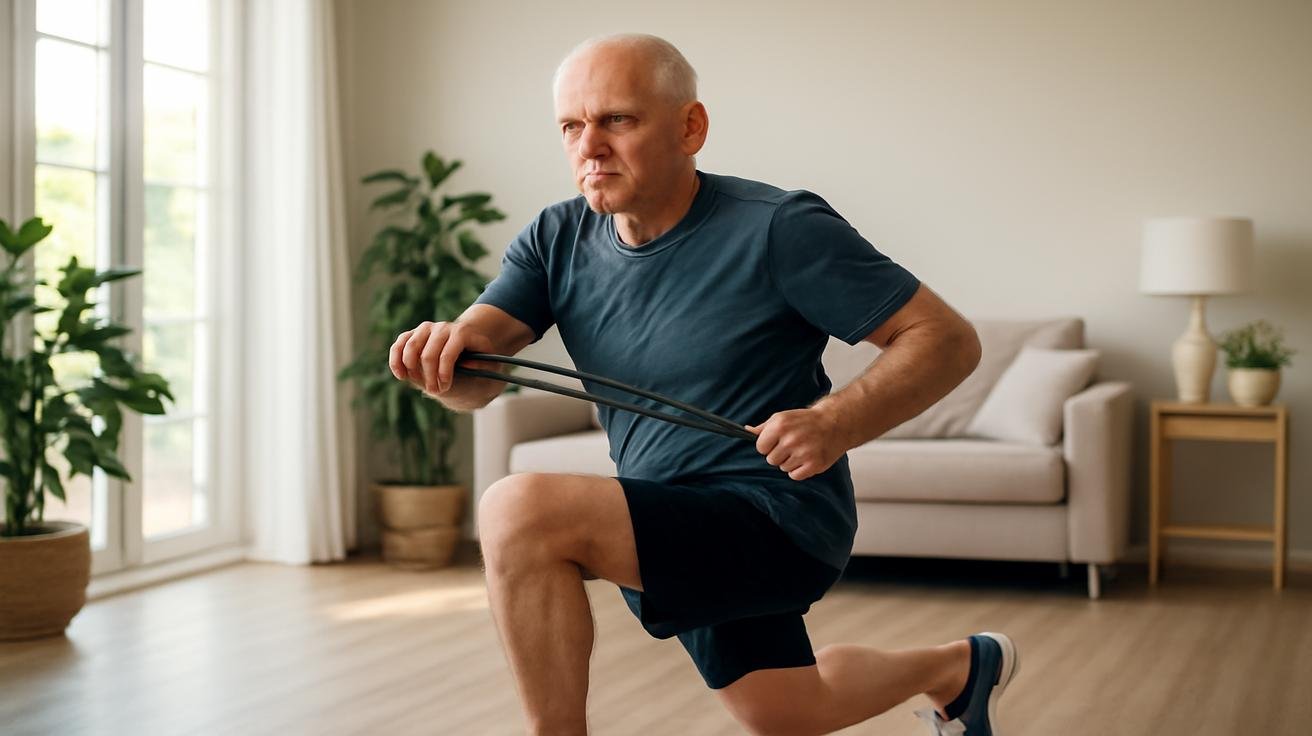
The house was so quiet after her husband died that the tick of the kitchen clock sounded like a hammer. At seventy-four, Lila caught herself standing at the window one afternoon, staring at the maple tree in the yard, wondering if this was it now: days measured in teacups, television reruns, and the occasional slow shuffle around the block that her doctor called “exercise.” She was doing what everyone said she should—thirty minutes of walking here, a light stretch there—but her body still felt like wet cardboard whenever she stood up from her favorite chair. Her legs wobbled. Her breath ran ahead of her. Her hands reached for furniture the way a sailor reaches for a rail on a stormy deck.
The Moment the Body Whispers “More”
It didn’t happen in a hospital or at a medical appointment. It happened in the narrow hallway of her small house on a rainy Thursday. Lila dropped a spoon. It hit the tile and bounced under the sideboard.
She bent to pick it up and realized, halfway down, that she didn’t quite know how to get back up without using her hands. She needed the sideboard. Then the chair. Then a deep breath and a little surge of panic. Her knees trembled. Her lower back ached. The spoon lay between her fingers, cold and thin, while a thought passed through her mind sharp as lightning: If I fall, I might not get up.
That thought is where this story, and this movement pattern, really begin.
We’ve built a culture around neat little boxes of exercise: daily walks, water aerobics, yoga classes with names printed in soft pastel fonts. All of these can be good. But after seventy, there is a different kind of movement that quietly becomes the star of the show if you want to extend your healthspan—the years of life you can actually live on your own terms, not just stay alive.
It’s not a gym membership. It’s not a daily step goal. It’s something more ordinary and, in its own way, more radical.
The Pattern That Keeps You Out of the Chair
A few weeks after the spoon incident, Lila’s grandson visited with his two-year-old daughter, Emma. While the adults talked, Emma played on the living room floor—a scattered kingdom of blocks, dolls, and puzzle pieces. Lila watched the little girl with an almost scientific curiosity.
Emma dropped to the floor, sat cross-legged, then on her knees, then squatted, then rolled over, then stood up without using her hands, then balanced on one foot to step over a toy. She repeated this endlessly, without thinking, completely absorbed in the business of being a body.
That afternoon, as if a curtain lifted, Lila saw something that most of us lose sight of by middle age:
The most important movement pattern for living well after seventy isn’t “exercise” in the way we usually define it. It’s the daily ability to get down to the ground and back up again, to move your body through different levels and directions, comfortably and confidently.
This is sometimes called “floor-to-stand” mobility, or ground movement. It looks deceptively simple, but it weaves together strength, balance, coordination, joint health, and even brain health in a single, seamless pattern. If daily walking is like reading the same page of a book over and over, floor-to-stand movement is like reading the entire chapter—rich, varied, and full of information for your nervous system.
Why Floor-to-Stand Beats the Simple Step Count
Think about almost every dangerous situation that scares older adults and their families: a fall in the bathroom, a misstep in the garden, a slip on stairs, tripping over a rug. The injury from the fall is one problem; the inability to get up from the floor afterward is often far more serious. That’s when independence begins to erode.
Daily walks and weekly gym sessions rarely rehearse this scenario. Treadmills teach you to go forward on a flat surface. Stationary bikes teach you to sit and push. Machines stabilize your body for you. But life doesn’t arrive in straight lines and controlled settings. It happens in clumsy twists, sudden reaches, low cabinets, and shoes you drop and need to put back on.
Floor-to-stand movement trains the “messy middle” of living: the transitions, the recoveries, the in-between moments when you’re shifting from chair to standing, turning, reaching, kneeling, squatting, and then reversing all of that in a different order.
After seventy, the nervous system desperately wants these rehearsals. They’re like insurance for your future self.
What This Movement Pattern Actually Looks Like
Imagine you’re at home. There’s a sturdy chair nearby. The floor is clear of clutter. You’re wearing comfortable clothes and non-slip shoes or bare feet.
This pattern is not a strict workout; it’s more like a flowing dance between three levels: standing, middle (chair height or kneeling), and floor. You visit these levels and leave them again, in different ways, at your own pace.
You might:
- Stand beside the chair, then slowly lower yourself to sit and rise again, focusing on control.
- From sitting, slide one knee down to the floor into a half-kneeling position, using the chair for support.
- From half-kneeling, place both knees on the ground and rest in a comfortable kneeling position.
- Then shift to sitting on the floor—side-sitting, cross-legged, or with legs outstretched.
- Reverse the journey, step by step, back to standing.
This is the pattern: standing → chair → kneeling → floor → kneeling → chair → standing, with countless small variations. Done regularly, it becomes a gentle but powerful conversation between your muscles, joints, balance system, and brain.
There’s no scoreboard. No heart-rate zones. Just an honest question repeated over and over: Can I get down here? Can I get back up?
The Subtle Science Behind a Simple Move
Scientists and geriatric specialists have quietly noted something striking: older adults who can sit down on the floor and stand back up with minimal support tend to live longer and maintain independence longer. This doesn’t just reflect strength; it reflects balance, flexibility, coordination, and confidence all at once.
When you practice floor-to-stand movements regularly:
- Your leg strength improves in ways that matter for climbing stairs, getting off the toilet, and stepping over obstacles.
- Your hips and ankles regain some of the flexibility that daily walking alone rarely challenges.
- Your core—those deep trunk muscles—learn to stabilize you as you twist, reach, and shift weight.
- Your balance system is constantly engaged, adapting to different angles, levels, and points of support.
- Your brain builds and maintains neural pathways that link movement, planning, and spatial awareness.
In short, this pattern is like cross-training for aging. You’re quietly upgrading the full operating system rather than just one app.
From Theory to Living Room: How Lila Changed Her Days
At first, the idea frightened her. Floor work is for children and gymnasts, she told herself. But the next week, her doctor mentioned something almost identical to what she’d been watching in her great-granddaughter: “If you really want to stay independent,” he said, “practice getting down to the floor and back up. Often. Safely. That matters more than any number of steps.”
So she started small.
In the afternoon, instead of just sitting and knitting, she placed a folded blanket on the floor near the coffee table and an armchair. On day one, she only practiced going from standing to sitting in the chair and back up, ten times, slow and controlled. Her legs shook. She felt a little embarrassed, alone in the room with no one watching.
By the end of the week, she experimented with lowering one knee onto the blanket while holding the table, then returning to the chair. Her joints protested, but not in a dangerous way—more like a rusty door hinge asking for oil. She moved gently, listening carefully to the difference between discomfort and pain.
A month later, she could sit on the blanket, both knees bent, and stand up again using her hands on the chair. It wasn’t graceful. It wasn’t fast. But it was possible. And in that possibility, something in her eyes lit up—the look of someone who has remembered a language they thought they’d forgotten.
A Simple Weekly Pattern You Can Feel
Here is a gentle template, adaptable to most people over seventy who have medical clearance to move:
| Day | Focus | Example Movements |
|---|---|---|
| Monday | Chair to Stand | Sit-to-stand from chair, 2–3 sets of 5–8 reps, holding armrests as needed. |
| Wednesday | Kneeling Transitions | From chair, lower one knee to a cushion, then return; alternate legs, 5 reps per side. |
| Friday | Floor Sit & Rise (Assisted) | Using a sturdy chair or low table, slowly sit on the floor and stand back up, 3–5 times, resting as needed. |
| Saturday | Free Movement Practice | 5–10 minutes exploring different floor positions (side-sitting, cross-legged) and gentle transitions. |
On the other days, you can still walk, garden, or attend a class. But these sessions anchor the week around the key pattern: floor-to-stand and back again.
The Emotional Weight of Getting Off the Floor
It’s tempting to talk about movement only in terms of muscles and bones, but something else happens when you reclaim the floor as a friend instead of an enemy.
Fear loosens its grip.
One of the quiet tragedies of aging is how many people shrink their lives to a narrow strip of safe territory: the bed, the bathroom, the favorite chair, the car. Grass becomes hazardous. Sand feels treacherous. Stairs loom like cliffs.
Practicing floor-to-stand mobility is like reopening the map. When you know you can get down and get up, the world feels less like a field of land mines and more like a place you can still inhabit fully.
For Lila, that meant kneeling in the garden again. At first, she brought a low stool, lowering herself with care and using a trowel as both tool and ground contact. Her neighbors watched her from their windows, half in shock. Didn’t she know she was “too old” to be on the ground?
She knew something different: every time she knelt and stood, every time she sat on the path and levered herself up with a grunt and a laugh, she was buying more time in the life she actually wanted.
How to Start If You’re Scared (Or Stiff, Or Unsure)
If you’re reading this and thinking, “I could never get down to the floor,” that’s not a failure. That’s a starting point.
Begin where you are:
- If standing up from a chair is hard, make that your practice. Use your arms as much as needed. Lower slowly, stand carefully. Over time, see if you can use your arms a little less.
- If kneeling hurts, add cushions or folded blankets. Try touching one knee down for a moment, then coming back up. Explore smaller ranges before bigger ones.
- If getting to the floor feels impossible, work at higher levels first. Even lowering your body toward a low ottoman and back up trains much of the same pattern.
- If balance is a concern, use a kitchen counter, a bed, or a sturdy table as your “safety rail.” Move near a wall. Have a family member nearby at first.
What matters most is not how low you go today, but how much of your body you’re willing to bring back into the conversation. Every new angle is new information for your nervous system.
Healthspan vs. Lifespan: The Quiet Revolution
Medical advances have stretched our lifespan, keeping us alive longer. But without movement that challenges the full body, our healthspan—the years we can dress ourselves, cook, bathe, garden, travel, and play—often stalls far earlier.
When researchers look at what predicts a longer healthspan after seventy, they find some familiar things: strength, balance, low fall risk, good cognitive function. The floor-to-stand pattern is a practical way to touch all of these at once without complicated equipment or environments.
Think of it this way: a stationary bike might help your heart and legs. A simple walk might help your mood and joints. But the pattern of getting down, moving around, and getting back up—that’s rehearsal for life itself.
In this sense, floor-to-stand is not just an exercise. It’s a quiet revolution against passivity. It says, “I’m still in the game.” Not as a spectator, but as someone willing to bend, reach, twist, and rise for as long as possible.
A Different Kind of Fitness Legacy
One spring afternoon, months into her new ritual, Lila’s family gathered for a picnic at a local park. The grass was soft and slightly damp; children shrieked and ran circles around the grown-ups. Someone laid out blankets under a tree. There was the usual scramble of folding chairs, paper plates, and coolers.
Lila did something she hadn’t done in years.
She lowered herself, slowly but without panic, onto the blanket. She sat cross-legged, then shifted to lean on one hand and stretch her legs in front of her. She watched the clouds through the branches. Her granddaughter handed her the baby, and she held the small, warm body against her chest, feeling utterly grounded.
Later, when it was time to go, one of her sons rushed forward. “Let me help you up, Mom,” he said, already reaching out.
“Just a second,” she smiled.
She rolled to one side, came onto hands and knees, placed one foot flat on the ground, pushed through her legs, and—slowly, like the unfurling of a fern—stood up. Not without effort. Not without age. But without fear.
Her children stared. Her great-granddaughter, watching with wide eyes, beamed as if her great-grandmother had just performed a magic trick. In a way, she had.
That’s the legacy of this movement pattern. It’s not about impressing anyone at the gym. It’s about dropping a quiet stone into the pond of your own life and watching the ripples move outward—to your family, your community, and the stories people tell about what it means to be old.
Frequently Asked Questions
Is it safe to practice floor-to-stand movements if I have arthritis?
Many people with arthritis can benefit from gentle floor-to-stand practice, but it must be adapted. Use cushions, limit how far you bend your joints, move slowly, and avoid positions that cause sharp pain. Consult your healthcare provider or a physical therapist first, especially if your arthritis is severe or flares often.
What if I can’t get to the floor at all right now?
Start from where you are. Practice sit-to-stand from different chair heights, step-ups onto a low step, and supported half-kneeling using a chair or bed. These higher-level transitions build the strength and confidence you’ll eventually need to move closer to the floor.
How often should I do this type of movement after seventy?
Even 3 sessions per week can make a real difference, especially if you’re consistent. Each session might last 10–20 minutes. More frequent, shorter bouts—like 5 minutes most days—also work well and can feel less intimidating.
Does this replace walking or my other exercise?
No. Think of it as a missing piece, not a replacement. Walking is great for general health; strength or balance classes can help too. Floor-to-stand patterns tie these benefits together and directly support independence. Ideally, you keep doing your existing movement while adding this pattern.
What if I’m afraid of falling while practicing?
Set yourself up for safety. Practice near a sturdy surface like a bed, couch, or kitchen counter. Remove clutter and loose rugs. Have someone nearby when you first begin. Move slowly, stay within your comfort zone, and stop if you feel dizzy, unsteady, or overwhelmed. Progress may be slow, but every safe, thoughtful repetition builds trust in your body.
Can this kind of movement really improve my healthspan, not just my strength?
Yes. Because floor-to-stand practice involves strength, flexibility, balance, coordination, and decision-making, it supports the systems that protect independence: fall prevention, daily task ability, confidence, and even cognitive engagement. Over time, that can translate into more years of life that you can live on your own terms, rather than simply existing.
Am I too old to start if I’m already over eighty?
As long as your healthcare provider clears you for gentle movement, it’s almost never too late to start. The goal isn’t perfection; it’s progress—maybe from needing a lot of assistance to needing a little, or from avoiding the floor entirely to feeling safe using a low stool or cushion. Even small improvements can have an outsized impact on daily life and confidence.