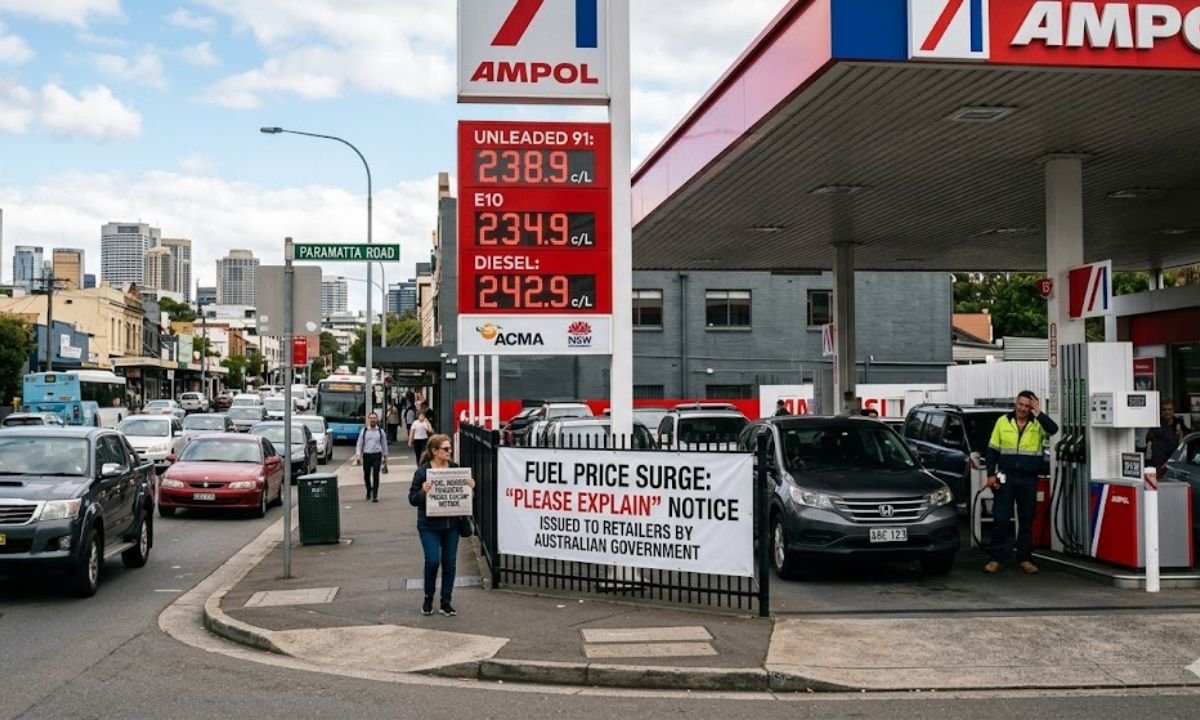
Petrol prices in Australia have surged past $2.15 per litre in March 2026, particularly in major capital cities such as Sydney, Brisbane, and Melbourne. Motorists across the country are feeling the financial pressure as fuel costs rise sharply, with some regional areas experiencing even higher prices.
The sudden spike has prompted the Australian Competition and Consumer Commission (ACCC) to issue a “please explain” notice to petrol retailers. Regulators are questioning why prices rose so quickly, especially since fuel increases typically occur when demand rises and supply tightens. In this case, the ACCC suspects that some companies may be raising prices faster than justified by market conditions.
Global Oil Prices and Middle East Tensions Driving Costs
A major factor behind the surge is the ongoing geopolitical tensions in the Middle East, which have pushed global oil prices above $100 USD per barrel. Higher crude oil prices increase wholesale fuel costs globally and influence the price benchmark used in Singapore, which directly affects Australian petrol pricing.
Federal Energy Minister Chris Bowen and ACCC Commissioner Anna Brakey have both suggested that some fuel retailers could be using global instability as an excuse to increase prices more aggressively than necessary.
Fuel Price Snapshot – March 2026
The latest data highlights how significantly fuel costs have increased across Australian cities:
- Sydney – $2.18 per litre (24% increase) – $109 to fill a 50-litre tank
- Melbourne – $2.16 per litre (23% increase) – $108 to fill a 50-litre tank
- Brisbane – $2.18 per litre (25% increase) – $109 to fill a 50-litre tank
- Perth – $2.10 per litre (19% increase) – $105 to fill a 50-litre tank
- Adelaide – $1.85 per litre (11% increase) – $92.50 to fill a 50-litre tank
- Canberra – $2.12 per litre (22% increase) – $106 to fill a 50-litre tank
While all cities are experiencing price increases, local fuel price cycles mean that some areas are temporarily seeing lower averages compared to others.
Government Steps In With Emergency Measures
To stabilize supply and prevent shortages, the Australian government has unlocked emergency fuel reserves. Authorities are also monitoring the industry closely to ensure companies are not exploiting consumers during a period of rising living costs, inflation, and higher interest rates.
The government has also taken action to support regional areas where diesel shortages have been reported by farmers and transport operators. The Minimum Stockholding Obligation (MSO) has been temporarily eased by 20%, which is expected to release around 760 million litres of petrol and diesel into the market.
Stricter Regulations and Heavy Penalties Introduced
In response to public backlash, Australia has introduced stricter fuel market regulations in 2026. Maximum penalties for misleading conduct have been doubled, allowing regulators to impose fines of up to $100 million for each violation.
Victoria has also introduced new daily reporting requirements. Fuel retailers must now submit their highest prices by 2PM for the following day, and those prices must remain fixed for a 24-hour period starting at 6AM.
This rule aims to stop sudden price spikes during the day that force drivers to pay significantly more on their commute home.
Price Differences Between Nearby Service Stations
Experts have noted that fuel prices can vary dramatically between nearby service stations. In some suburbs, stations located less than a minute apart have price differences of more than 30 cents per litre.
While regulators investigate the market, experts recommend that drivers actively compare prices using real-time fuel apps.
Fuel Apps Helping Drivers Find Cheaper Petrol
Several fuel-tracking apps are helping Australian motorists locate cheaper fuel options:
- PetrolSpy
- My NRMA
- Servo Saver (Victoria Government)
These apps provide real-time price comparisons, helping drivers avoid paying unnecessarily high prices during volatile fuel cycles.
FAQs
Q1 Why did petrol prices increase when old stock had not run out?
The ACCC is currently reviewing this issue. Normally, there is a one-week lag between global oil price increases and retail fuel prices. However, some retailers increased prices much sooner, raising concerns that they may be responding to expected price changes rather than actual costs.
Q2 What does the ACCC “please explain” notice mean?
A “please explain” notice is a formal request from the ACCC asking companies to justify their pricing decisions. If the investigation finds evidence of misleading conduct or price-fixing, the regulator can take the matter to court with potential fines of up to $100 million.
Q3 How can drivers find cheaper fuel?
Drivers are encouraged to use fuel price tracking apps. In Victoria, the Servo Saver app shows the maximum price for the following day after 4PM, allowing motorists to plan when to fill up.