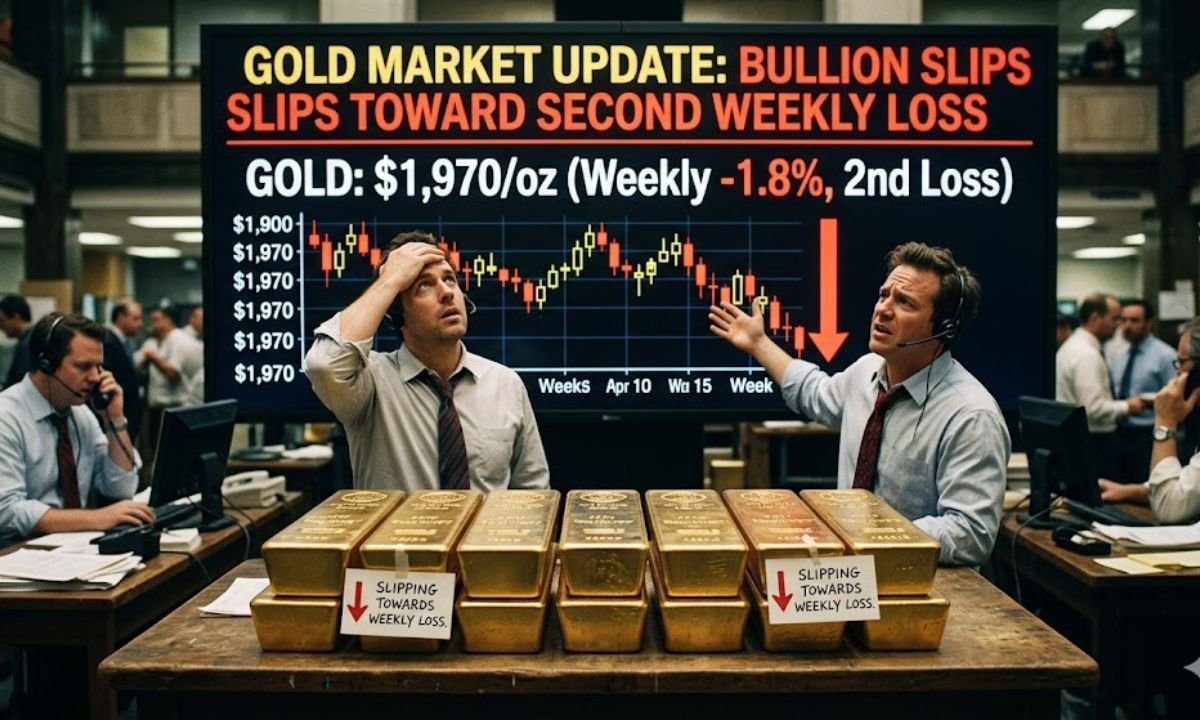
The gold market has entered a phase of consolidation in March 2026, with bullion prices heading toward a potential second consecutive weekly loss. After touching record highs earlier this year, gold is now facing renewed pressure from a strengthening US dollar and shifting expectations around interest rates.
Gold prices recently slipped below the key psychological support level of $5,000 per ounce. The US Dollar Index (DXY) moving above 100.00 has strengthened the greenback, making gold more expensive for international buyers and reducing overall demand.
Rising Treasury Yields Increase Opportunity Cost for Gold Investors
Another factor weighing on gold is the rise in US Treasury yields. The 10-year Treasury yield recently climbed to 4.29%, making non-yielding assets such as gold less attractive for institutional investors and commercial trading desks.
Higher yields increase the opportunity cost of holding gold, which does not generate interest. As a result, many investors are reallocating funds toward interest-bearing assets, contributing to the recent pullback in bullion prices.
Meanwhile, rising crude oil prices — now trading above $115 per barrel — have added inflationary pressure across global markets. Higher energy prices tend to push Treasury yields upward, further intensifying the headwinds for gold.
Federal Reserve Policy Outlook Adds Market Uncertainty
Market sentiment toward the Federal Reserve’s policy path in 2026 has also shifted. Earlier expectations suggested more aggressive interest rate cuts this year. However, rising energy prices and persistent inflation have forced investors to reconsider that outlook.
Recent macroeconomic data shows that the US economy is slowing while inflation remains elevated. The fourth-quarter US GDP growth came in at 0.7%, indicating a deceleration in economic expansion. At the same time, the Core Personal Consumption Expenditures (PCE) Price Index remained elevated at 3.1%.
This combination of slower growth and persistent inflation has sparked concerns about a stagflation-like environment. As a result, many analysts now expect the Federal Reserve to keep interest rates higher for longer, creating a challenging environment for gold in the short term.
Central Bank Demand Continues to Support Long-Term Gold Outlook
Despite the current price decline, long-term fundamentals for gold remain strong. Central banks around the world continue to increase their gold reserves as part of diversification strategies.
Countries such as China, India, and Uzbekistan are believed to have been actively adding gold to their reserves during the early months of 2026. Reports suggest that global central bank purchases in January and February reached record levels.
Investor demand in India has also been strong. Gold exchange-traded funds (ETFs) in India recently surpassed 100 tons for the first time, reflecting increasing participation by retail and institutional investors.
Technical Indicators Suggest Ongoing Uptrend
Market analysts expect the current correction to potentially push gold prices toward $4,925 in the near term. However, technical indicators such as the Daily Parabolic SAR suggest that the broader uptrend established during 2025 remains intact.
Some analysts believe the current decline represents a healthy consolidation after the strong rally seen in early February. Given the elevated geopolitical risks and growing global debt levels, gold continues to maintain its status as a key store of value.
FAQs
Q1 Why is gold falling despite geopolitical tensions?
Although gold is traditionally considered a safe-haven asset, rising oil prices and persistent inflation have strengthened the US dollar and pushed Treasury yields higher. These factors increase the opportunity cost of holding gold and reduce investor demand.
Q2 What do analysts think about the recent price drop?
Many analysts believe the current pullback toward the $5,000 level could provide attractive entry points for long-term investors. Structural demand from central banks and the need for protection against global debt continue to support the long-term outlook for gold.
Q3 How has silver performed compared to gold?
Silver tends to be more volatile than gold. Unlike gold, which is primarily seen as a store of value, silver also has significant industrial demand. As a result, silver prices are often more sensitive to changes in global economic growth expectations.