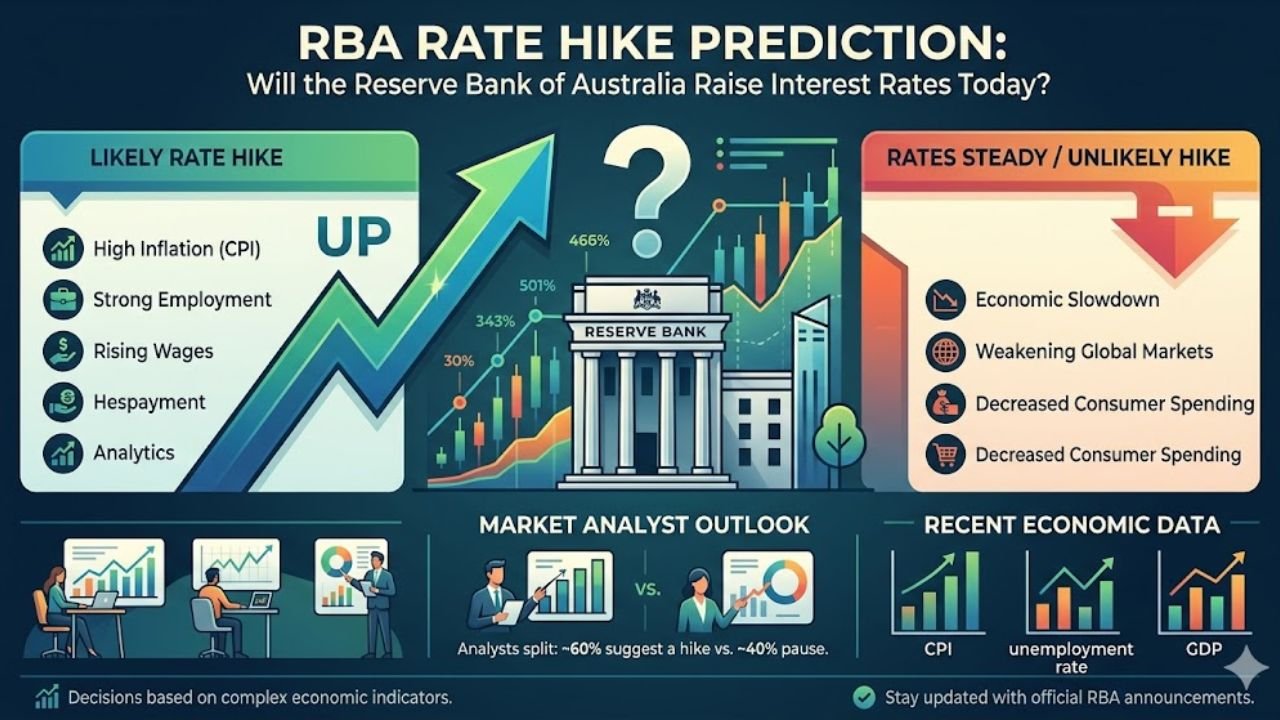
Australia has once again come under focus following a major monetary policy shift. On Tuesday, March 17, 2026, the Reserve Bank of Australia (RBA) raised the official cash rate by 25 basis points, moving it from 3.85% to 4.10%. This marks the second consecutive monthly increase, reflecting the central bank’s continued effort to control inflation and stabilize the economy.
Households and businesses are increasingly feeling the pressure of rising costs, as the RBA intensifies its fight against persistent inflation. The central bank’s decision underscores its commitment to addressing domestic economic pressures, particularly as inflationary trends are expected to strengthen further in the second half of 2025.
Inflation Remains Above Target Band
According to the Australian Bureau of Statistics, headline inflation stood at 3.8% as of January 2026, remaining above the RBA’s target range of 2%–3%. This persistent elevation has been a key driver behind the rate hike.
Adding to the concern, capacity pressures across the economy continue to exceed earlier expectations. With unemployment holding steady at around 4.1%, the labor market remains tight. Strong demand for goods and services continues to outpace supply, creating ongoing inflationary pressure.
Global Factors Add to Economic Uncertainty
Beyond domestic conditions, global geopolitical tensions—particularly in the Middle East—are contributing to economic uncertainty. Disruptions in energy markets and shipping routes have led to rising petrol prices, which are beginning to ripple through supply chains.
RBA Governor Michele Bullock highlighted that while fuel prices were not the sole reason for the rate hike, sustained increases could push inflation expectations higher, potentially reaching 5% annually if left unchecked.
Key Economic Indicators Reviewed by the RBA
| Indicator | January 2026 | Previous Quarter (Oct–Dec 2025) | Projection |
|---|---|---|---|
| Cash Rate | 3.85% | 3.6% | 4.10% (March 2026) |
| Headline CPI | 3.8% | 3.6% | 3.5% (expected April) |
| Unemployment Rate | 4.1% | 4.1% | 4.1% |
| Trimmed Mean Inflation | 3.4% | 3.4% | 3.4% |
| Wage Price Index | 3.4% | 3.2% | 3.5% (Q1 2026 projected) |
Impact on Households and Borrowers
The latest rate increase is expected to significantly impact borrowers, especially those with variable-rate mortgages. Analysts estimate that a 25-basis-point hike could increase monthly repayments by approximately $91 on a $600,000 loan.
As borrowing costs rise, disposable income is likely to decline, placing additional financial strain on Australian households.
Balancing Inflation and Economic Stability
The RBA’s decision reflects a delicate balancing act between controlling inflation and maintaining financial stability. By tightening monetary policy, the central bank aims to reduce aggregate demand and align it more closely with the economy’s supply capacity.
The Road Ahead for Monetary Policy
Looking forward, the RBA has indicated that future rate decisions will remain data-dependent. The split vote among board members highlights ongoing debate about the pace and timing of further tightening.
The next RBA meeting is scheduled for May 4–5, 2026, just ahead of the Federal Budget release. Key factors under observation include the upcoming first-quarter CPI data and developments in global geopolitical conditions.
For now, the RBA remains firmly committed to bringing inflation back within its target range—even if it means short-term economic pain for households and businesses.
FAQs
Q1 Did the RBA raise interest rates today?
Yes, the Reserve Bank of Australia increased the official cash rate by 25 basis points to 4.10% on March 17, 2026.
Q2 What caused the RBA to raise rates again?
The decision was driven by persistent inflation at 3.8%, a tight labor market, and rising global energy prices influenced by geopolitical tensions.
Q3 When is the next RBA rate meeting?
The next RBA meeting is scheduled for May 4–5, 2026.